Nearshore vs Offshore Outsourcing for European Companies
Nearshore and offshore outsourcing both reduce costs, but they suit different business needs. Here is how to choose the right model for a European operation.

European companies looking to outsource support, operations, or technical functions face a consistent choice: nearshore geographically close, with similar timezone and cultural alignment or offshore, with a significant timezone gap and greater cultural distance. Both can reduce costs. The right choice depends on what you are outsourcing, how closely it needs to integrate with your internal operations, and what the real cost of misalignment is for your business.
What Is Nearshore Outsourcing?
Nearshore outsourcing for a European company means working with a provider in a country that shares or closely overlaps your timezone. For a UK or Western European company, this typically means Central or Eastern Europe � countries like Kosovo, Albania, North Macedonia, Serbia, Romania, or the Baltic states. The defining characteristic is that your outsourced team works during the same business hours as your internal team, enabling real-time communication without shift complexity.
Nearshore locations offer lower cost than Western Europe without the timezone and communication friction of offshore. The trade-off is that cost reduction is typically smaller than offshore � you are not accessing the lowest-cost labour markets in the world. You are accessing competitively priced labour in your timezone.
What Is Offshore Outsourcing?
Offshore outsourcing for a European company typically means the Philippines, India, South Africa, or Latin America. These locations offer lower cost per agent than nearshore options and in some cases strong English proficiency. The trade-off is timezone separation � typically four to twelve hours depending on the location � and greater communication overhead.
For high-volume, process-driven work that does not require real-time integration with your internal team, offshore can be effective and cost-efficient. For work that requires frequent synchronous communication, rapid escalation, or close collaboration with your internal operations, the timezone gap creates friction that reduces the net benefit.
Key Differences for European Companies
The comparison between nearshore and offshore for a European company usually comes down to five factors:
- Timezone: nearshore operates in or near your timezone; offshore operates with a multi-hour gap that limits synchronous working hours
- Language alignment: both can offer strong English; nearshore often provides better coverage for European languages including German, French, Italian, and Dutch
- Cultural proximity: nearshore locations share more cultural context with European consumers, which matters for customer-facing roles where nuance is important
- Cost: offshore is typically lower cost per agent than nearshore; the gap varies by location and function
- Integration friction: nearshore integrates more easily with European internal operations due to business hour overlap; offshore requires deliberate process design to manage the handover
When Nearshore Is the Right Choice
Nearshore outsourcing is usually the right choice for customer-facing functions where real-time or near-real-time integration with your team is important: live chat, same-day email response, technical support escalations, and operations roles that involve frequent decision-making within your business day. It is also the right choice when your customers are European and you want agents who share cultural context with them.
Companies that have tried offshore for customer-facing work and encountered escalation delays, missed handovers, or tone issues often move to nearshore as a correction. The timezone alignment alone resolves a significant proportion of the operational friction that offshore creates for synchronous work.
When Offshore Makes More Sense
Offshore is a strong choice for back-office processing, data entry, document review, and other asynchronous tasks that do not require real-time European overlap. It is also effective for 24-hour coverage models where you want a shift that works during European off-hours � the timezone gap becomes an asset rather than a liability.
If your primary driver is the lowest possible cost per ticket or per task, and the work can be structured to run asynchronously, offshore delivers a better cost position than nearshore. The key is being clear-eyed about whether your work type genuinely supports asynchronous operation.
For European companies considering nearshore customer support outsourcing, visit our customer support outsourcing for European companies page. You can also review our nearshore outsourcing Kosovo page, or contact us to discuss which model fits your operation.
Frequently Asked Questions
Is nearshore always more expensive than offshore?
Per agent, typically yes. However, the total cost of delivery � when you account for management overhead, quality correction, escalation delays, and the value of real-time integration � can make nearshore more cost-effective than offshore for synchronous work.
Can I mix nearshore and offshore for different functions?
Yes. Many companies use nearshore for customer-facing, synchronous work and offshore for back-office or asynchronous processing. This multi-geography approach requires careful scoping of what belongs where but can optimise cost across the operation as a whole.
How does cultural alignment affect customer support quality?
Cultural alignment affects tone, communication style, and the ability to handle nuanced customer situations. For European customers, agents who share European cultural context handle ambiguous situations more naturally. The impact is most visible in complex or sensitive interactions.
What are the main risks with offshore customer support for European companies?
The main risks are timezone-driven response delays, communication overhead when escalations cross a large timezone gap, and cultural misalignment in tone. These risks are manageable with good process design but add overhead that nearshore does not require.
Does nearshore outsourcing in Kosovo support multiple European languages?
Kosovo-based teams can support English as the primary language and commonly also German. Other European languages depend on the specific provider and team composition. Confirm language availability during the scoping process rather than assuming it.
Need support teams or a better digital operation?
Talk to SD IT Services.
Related services
Nearshore Outsourcing Kosovo
Explore Kosovo-based support, operations, development, and QA delivery.
View pageOutsourcing Company Kosovo
See how SD IT Services operates as a managed Kosovo outsourcing partner.
View pageCustomer Support Europe
Build customer support coverage aligned with European working hours.
View pageRead Also
More SD IT insights.
Outsourcing
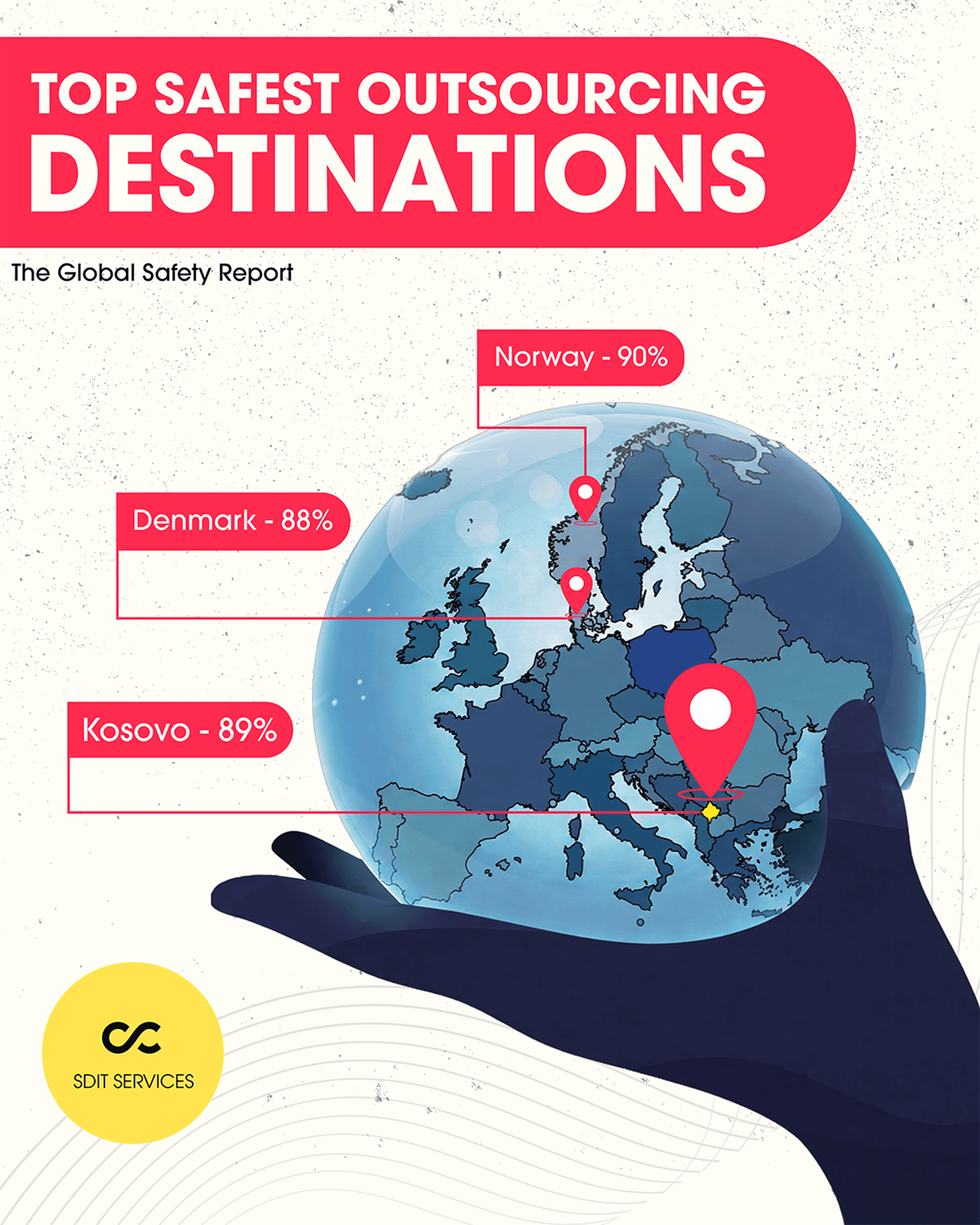
Kosovo Ranks Among the World's Safest Outsourcing Destinations (89%): What the Global Safety Report Means for Your Business
Read article
Technical Support
Why Growing Businesses Struggle with Efficiency (And How Better Processes Fix It)
Read article
Company
Website Redesign Checklist for Growing Companies
Read articleShare via
Summarize with AI
Copies a prepared prompt with this article title and URL, then opens your selected AI tool.